Common Names
English: Dusky Spinefoot, Squaretail Rabbitfish
Turkish: Sokar balığı, Sokan
Size
Average Size: 10-20 cm
Maximum Size: Up to 30 cm
Scientific Classification
Kingdom: Animalia
Phylum: Chordata
Class: Actinopterygii
Order: Perciformes
Family: Siganidae
Genus: Siganus
Species: Siganus luridus
Dusky Spinefoot Appearance
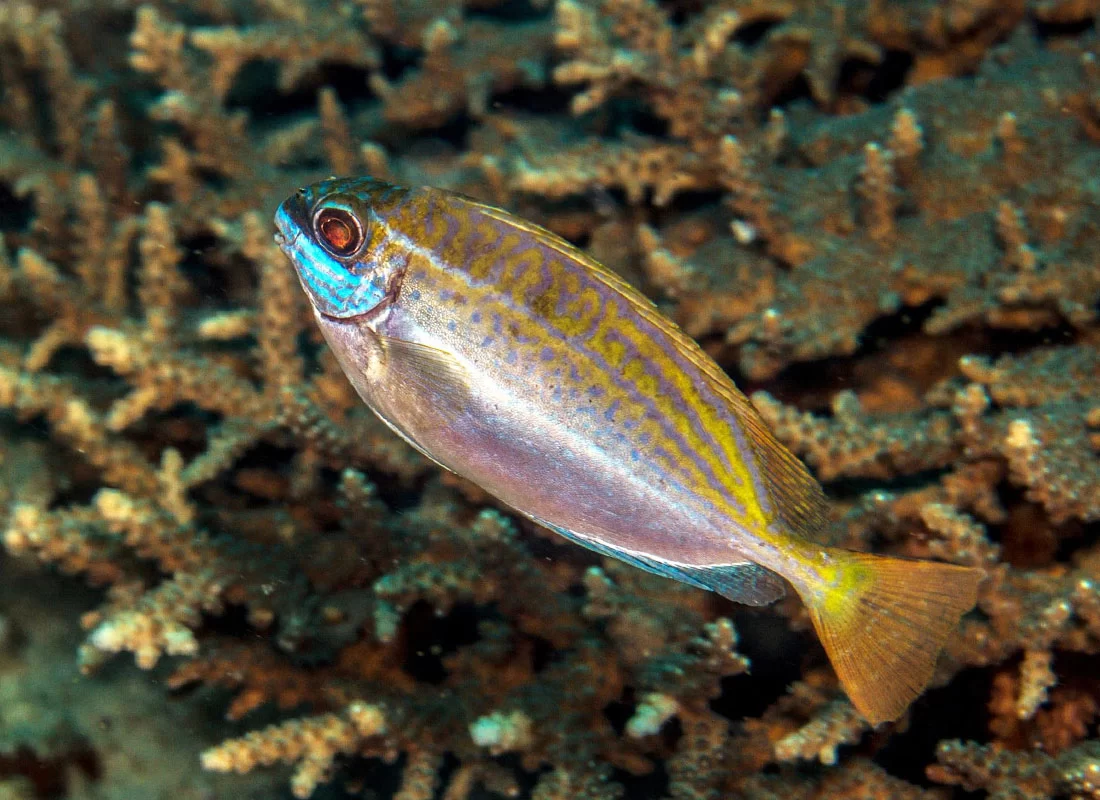
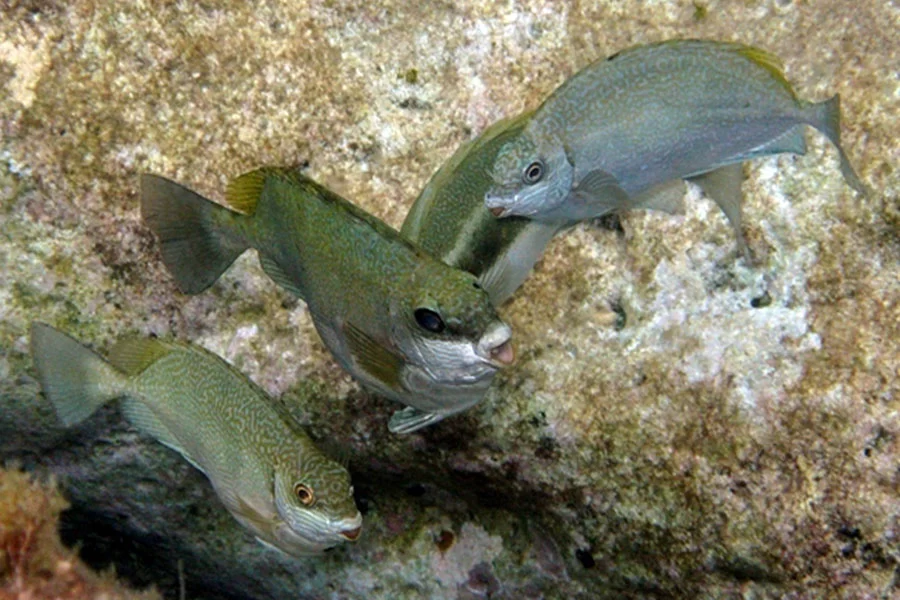
Compressed body with a depth that fits into its standard length 2.1 to 2.8 times. Single row of incisor-like teeth in the jaws, each with 1 or 2 lateral cusps. Dorsal fin contains 13-14 spines and 10 soft rays. Anal fin has 7 spines and 9 soft rays. Caudal fin is truncate (square-shaped). Color is variable, normally olive green to dark brown with a mottled pattern. Pectoral fins are hyaline-yellow. Dark bars are present on the caudal fin.
Distinguishing Features: Truncate caudal fin, mottled dark coloration, venomous spines.
Danger: Venomous spines can cause a very painful wound if handled incorrectly.

Siganus luridus, commonly known as the dusky spinefoot or squaretail rabbitfish, is a herbivorous marine species in the Siganidae family. Native to the Red Sea and western Indian Ocean, it has successfully colonized the Mediterranean Sea via Lessepsian migration through the Suez Canal. Like other members of its genus, S. luridus is a schooling species often observed in pairs or small groups, playing a significant role in shaping algal communities in its habitats.
Conservation Status:
The Dusky Spinefoot features a deep, laterally compressed body and typically measures between 15–20 cm in length, with some specimens reaching up to 30 cm. It possesses sharp, venomous spines along its dorsal and anal fins, which it uses for defense against predators. While the sting can cause intense localized pain, the venom—being heat-sensitive—can be treated by immersing the affected area in hot water (approximately 43–46°C), effectively neutralizing its effects.
Visually, this species has a muted brown to olive-gray coloration, often with a uniform appearance lacking the prominent markings seen in related species. It primarily grazes on benthic algae, contributing to the control of algal overgrowth on rocky reefs. Occasionally, its diet may expand to include gelatinous plankton like jellyfish and comb jellies, especially during seasonal shifts in food availability.
Regulations and Ban
Due to its invasivity and abundance, it is not a banned species in Türkiye. Fishing is open all year round without any specific regulations, but remember that 5 kg per person rule still apply.
Ecological Role
Herbivorous, grazing on algal communities. Together with the related Marbled Spinefoot (Siganus rivulatus), it has been implicated in the creation of “barrens” off the coast of Türkiye by overgrazing algal communities, reducing complexity, biomass, and biodiversity.
Diet: Algae.
Is Rabbitfish a Game Fish?
No.
But Rabitfish often becomes a target for avid fishermen.
Recreational Fishing
Actively targeted by recreational fishermen in Türkiye.
Habitat and Distribution
Found in shallow brackish and coastal waters over soft sandy or muddy substrates, at a depth of 2–40 m.
Distribution: Mediterranean Sea, Southern Aegean Sea coasts of Türkiye.
Siganus luridus has emerged as an ecological issue in the Mediterranean and Aegean Seas, where its invasive expansion disrupts local ecosystems. In contrast to its behavior within its native range, its intense herbivory in these regions poses a serious threat to essential seagrass habitats, particularly Posidonia oceanica, a cornerstone species supporting marine biodiversity.
The excessive grazing by this species jeopardizes coastal environments, leads to sediment destabilization, and outcompetes native herbivorous fish. As a result, it represents a significant invasive challenge that demands careful monitoring and effective management strategies.
Best Time to Fish
| Month | Fishing Quality |
|---|---|
| January | Fair |
| February | Good |
| March | Good |
| April | Good |
| May | Great |
| June | Great |
| July | Great |
| August | Great |
| September | Great |
| October | Good |
| November | Fair |
| December | Fair |
Best Time of Day: During daylight hours.
Water Temperature Considerations: More active in warmer months.
Quick Facts
| Common Names (English) | Common Names (Turkish) | Size | Habitat | Conservation Status |
|---|---|---|---|---|
| Dusky Spinefoot, Squaretail Rabbitfish | Sokar balığı, Sokan | 10-30 cm | Shallow coastal waters | Least Concern (LC) |